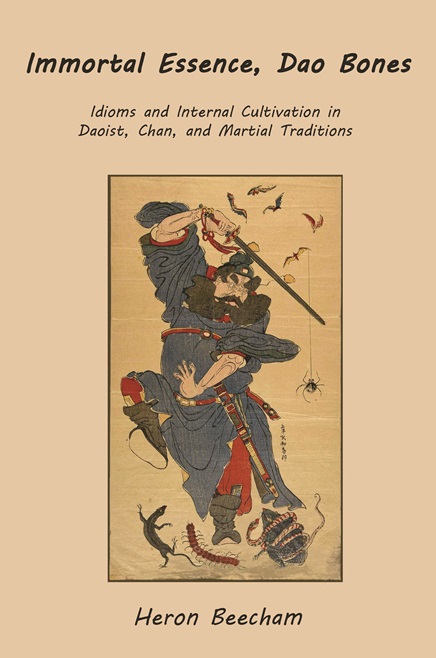
Idioms and Internal Cultivation in Daoist, Chan, and Martial Traditions
by Heron Beecham
This work opens a linguistic doorway into the heart of Chinese martial philosophy. Drawing on Daoist metaphysics, Buddhist principles, and Confucian ethics, this scholarly yet captivating work uncovers the hidden wisdom embedded in classical idioms—each one a vessel of cultivation, strategy, and inner transformation. Through vivid historical narratives, fieldwork with masters, and insights refined over decades of training, these ancient sayings emerge less as relics of the past and more as living tools of clarity, balance, and refinement. Whether reflecting on stillness within movement or the necessity to balance courage with restraint, each chapter opens a portal into a worldview shaped by discipline and spiritual inquiry. Part cultural history, part practical companion, the book interweaves language, lineage, and direct transmission, inviting readers to engage with tradition not as dogma but as a mirror through which the self may be transformed.
Paperback: US $35.95 plus S & H — PREPUBLICATION SPECIAL: US $28.50 plus S & H
PDF file $20.00, sent via email attachment within 24 hours
The Author:
Heron Beecham is a writer and longtime practitioner of Chinese internal martial arts, residing in Taiwan. His work bridges translation, fieldwork, and philosophy.
Praise
Plainspoken and principled, this book introduces the heart of the cultivation arts—extremely useful for sincere practitioners and powerfully informative for general audiences.— Master Kongming, founder of Xuangong
This book is a fascinating exploration of the author’s direct experience with traditional gongfu masters who transmitted not only skill, but also wisdom through the use of idioms and expressions passed down through the history of the arts. Heron does an excellent job presenting the personal aspects of the accomplished teachers with whom he studied, as well as the idioms themselves. Regarding those idioms, he has done background research to contextualize them with regards to the broader literary tradition, as well as addressing their usage and implication in colloquial society and the martial arts. These factors combine to make the book a good read and a valuable addition to the library of martial artists and scholars alike.—Steve Jackowicz, M.Ac., L.Ac., Ph.D., Chair Emeritus of the Doctoral Program in Traditional Chinese Medicine University of Bridgeport, founder Classical Martial Arts of Long Island
Immortal Essence, Dao Bones is an invaluable resource for students of Chinese martial arts seeking to explore the linguistic and cultural underpinnings of their practice, as well as for students of Chinese language and culture in general.— Robert Fox, Graduate Institute of Translation and Interpretation, National Taiwan Normal University
The language used in Daoism, Buddhism, and Chinese martial arts is never incidental—it is encoded and exacting. Immortal Essence, Dao Bones shows that what is often heard as a passing phrase or poetic flourish is, in fact, a compressed technology of practice and transmission. Each idiom carries a density that only reveals itself through time, repetition, and embodiment. By unpacking the stories and contexts behind them, Heron Beecham renders the richness of that density fully visible. An important contribution to our understanding of Chinese thought and cultivation.—Jeffrey S. Reid, author of Leaving the Mountains: A Daoist Journey from Obscurity to Modernity, and owner of Wudang Santa Cruz in California.